Vinyl record
A grooved disc, usually made from PVC, played by a stylus on a turntable. The groove carries an analogue representation of the music.

Physical media and audio come with a lot of specialist language. This searchable glossary explains the formats, recording terms, equipment and connections in plain English, so you can read a manual, shop for a system or follow a conversation with confidence.
Search a word or browse by subject. Definitions are short by design, and link to the deeper guides when a topic deserves more detail.
Physical carriers hold a recording in a form you can own, handle and play with compatible equipment.
A grooved disc, usually made from PVC, played by a stylus on a turntable. The groove carries an analogue representation of the music.
Short for long-playing record. An LP usually spins at 33⅓ rpm and holds an album across one or more sides.
A small record commonly played at 45 revolutions per minute, often with one main track on each side.
A 12 cm optical disc that stores digital audio. A standard audio CD holds up to about 74 or 80 minutes, depending on the disc and programme.
A recordable CD that can generally be written once. A compatible player must be able to read the disc and its recording format.
A rewritable CD that can be erased and recorded again. Many older CD players cannot read CD-RW discs.
The step that closes a recordable CD or DVD session so a wider range of players can read it. Follow the recorder instructions before finalising.
Disc information that tells a player where tracks begin and how they are arranged. An audio CD's TOC is read when the disc loads.
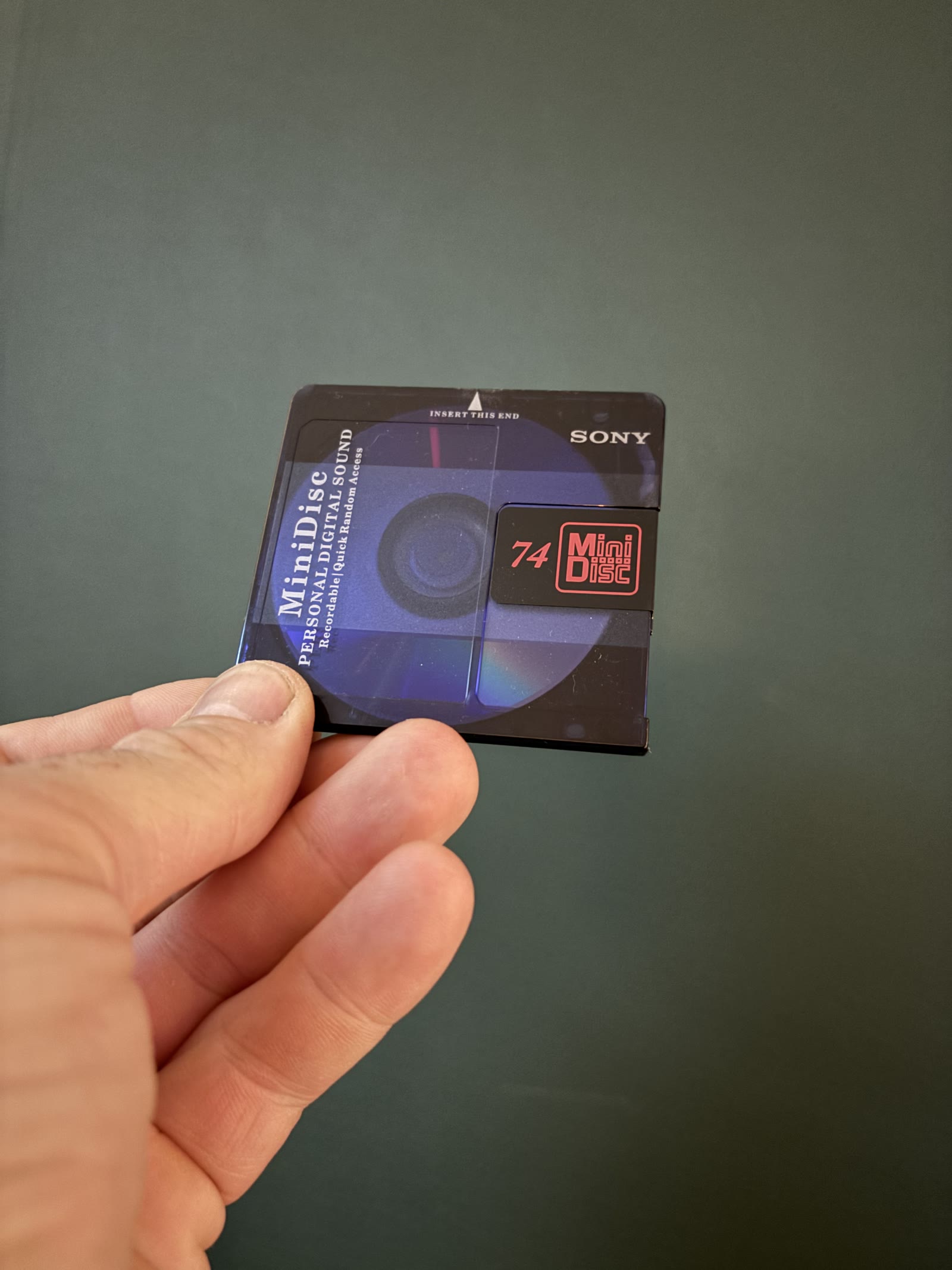
A small, protected optical disc format from Sony. Recordable MiniDiscs use magneto-optical recording and typically compress audio with ATRAC.
Adaptive Transform Acoustic Coding, Sony's family of perceptual audio codecs used by MiniDisc. Standard MiniDisc recording is lossy, while later Hi-MD modes differ.
A way to transfer compressed music from a computer to compatible MiniDisc recorders over USB. Web MiniDisc tools support some NetMD models.
A two-reel tape cartridge introduced by Philips in 1963. A cassette deck or portable player reads the magnetic recording from its tape.
Normal-bias ferric cassette tape, the most common cassette formulation. Use the deck's Type I setting unless the tape or manual says otherwise.
High-bias chrome or cobalt-doped cassette tape. It uses a different equalisation and bias setting from Type I tape.
Metal cassette tape, designed for high performance and requiring a deck with a Type IV setting.
Open-reel magnetic tape, wound between separate supply and take-up reels. It can offer long playing times and high quality, but needs a larger, carefully maintained machine.
An optical video disc format that can also contain digital audio. A DVD player can often play audio CDs, but check the model's supported formats.
An optical disc format with greater capacity than DVD, commonly used for HD video and high-capacity music or data releases.
A 4K video disc format with higher resolution and often HDR. It requires a compatible Ultra HD Blu-ray player and display.
These words describe how audio is captured, encoded, copied and presented.
A continuous electrical or physical representation of sound, such as the signal in a record groove or cassette tape.
Sound represented as numerical samples. CDs store digital audio that a player converts into an analogue signal for an amplifier.
The number of digital audio samples captured each second, measured in hertz. CD audio uses 44,100 samples per second.
The number of bits used for each digital audio sample. In PCM audio, greater bit depth allows a wider theoretical dynamic range.
An uncompressed digital audio format used on CDs and by many other devices. Some TVs can send PCM over optical or HDMI, which may suit a stereo amplifier. Surround formats need compatible equipment and settings.
Audio compression that preserves the original digital audio data when decoded, as with FLAC or ALAC.
Compression that discards some audio information to reduce file size. MP3, AAC and standard MiniDisc ATRAC are examples.
The span between the quietest and loudest sound a recording or system can reproduce clearly.
The final preparation of a recording for release on a particular format, including level, sequencing and any format-specific adjustments.
The device or recording from which music is played or copied, such as a CD player, turntable, tape deck, file or streaming service.
The signal strength sent to a recorder. Set it high enough for a healthy recording but low enough to avoid clipping or tape distortion.
A cue that tells a player or recorder where a track begins. Some formats allow track marks to be added during or after recording.
A personally selected and sequenced set of tracks, recorded or assembled to create a particular mood, journey or listening experience.
Wireless audio sent over Bluetooth. Most common Bluetooth audio codecs use lossy compression, and the codec depends on both devices.
Distortion caused when a signal exceeds the level a recorder, amplifier or digital system can handle cleanly.
Know what each box does, and which parts your listening room actually needs.
A component that provides the programme, such as a CD player, turntable, cassette deck, MiniDisc deck or network streamer.
A component combining source selection, volume control and power amplification for passive speakers.
An amplifier that includes a radio tuner. AV receivers also handle surround sound and video connections for a home cinema system.
Selects and controls low-level sources, and sends the signal to a separate power amplifier. Some preamps also include a phono stage.
Raises an audio signal to the power needed to drive passive loudspeakers. It normally works with a pre-amplifier or integrated source control.
A digital-to-analogue converter turns digital audio into an analogue signal. DACs are built into many CD players, streamers and amplifiers.
Amplifies the very small signal from a turntable cartridge and applies the record playback equalisation. It may be built into an amplifier or turntable.
The pickup fitted to a turntable tonearm. Its stylus follows the record groove and the cartridge converts that movement into an electrical signal.
The small diamond-tipped part of a cartridge that sits in the record groove. Keep it clean and replace it when worn or damaged.
A compact loudspeaker designed to sit on a shelf or, preferably, a stable stand. It can be a strong choice in a small room, and is not necessarily inferior to a floorstander.
A tall loudspeaker cabinet that stands directly on the floor. It may offer deeper bass or greater output, but room fit and sound quality depend on more than cabinet size.
A speaker driver designed mainly to reproduce low and mid-range frequencies.
A speaker driver designed to reproduce high frequencies, such as cymbals and upper harmonics.
The circuit that divides an audio signal into frequency ranges and sends them to the appropriate drivers in a speaker.
The electrical load a speaker presents to an amplifier, measured in ohms. Check that the amplifier supports the speaker's impedance.
A measure of how loudly a speaker plays for a given input. A higher sensitivity speaker generally needs less amplifier power for the same level.
Using separate cable pairs from compatible amplifier terminals to the separate input pairs on a speaker crossover. It is not the same as bi-amping, and does not guarantee better sound.
Using separate amplifier channels or amplifiers to drive different speaker sections. It requires compatible equipment and correct crossover arrangements.
Match the kind of signal and the job, not just the shape of a plug.
A common round connector for analogue line-level audio and some video. A red and white pair usually carries stereo left and right channels.
A standard analogue audio signal used between components, such as a CD player's output and an amplifier's AUX input.
The much smaller signal from a turntable cartridge, which needs a compatible phono stage before a normal line input.
A general analogue line input on an amplifier or car stereo. It does not identify a particular connector. Check whether the socket uses RCA or a 3.5 mm jack.
A small plug often used for headphones and portable players. A 3.5 mm to two RCA cable can connect a portable player's analogue output to a home amplifier's line input.
Two insulated conductors carrying amplified output from an amplifier to passive speakers. It is not interchangeable with RCA signal cable.
A US standard for wire diameter. A smaller AWG number means a thicker conductor. AWG and mm² are approximate equivalents, not identical size steps. See the speaker wire gauge table.
Oxygen-free copper, a copper purity specification used for some conductors. Correct size and sound construction matter more than the label alone for ordinary speaker wiring.
A pin-style connector fitted to speaker wire and inserted into a compatible binding post. It can make connections neat and quick, but bare wire also works with suitable terminals.
A fork-shaped speaker-wire connector that fits around a compatible binding post and is secured by tightening the terminal collar.
Speaker cable with its insulation stripped at the end so the conductor can be clamped directly into a speaker terminal.
The positive and negative orientation of speaker connections. Keep red to red and black to black on both speakers for consistent movement.
A digital audio connection that commonly uses a 75-ohm coaxial cable with RCA-style plugs. It carries digital data, not analogue stereo audio.
A fibre-optic digital audio connection that sends light pulses between compatible components. It carries audio, not video.
A digital audio port on some TVs and players that sends sound through a Toslink cable. It carries audio only. Connect it to an optical input on a compatible amplifier or AV receiver.
A port on an amplifier or receiver that receives digital sound from a TV or player over a Toslink cable. Select the matching input. Supported audio formats depend on the equipment and its settings.
Audio Return Channel. When a TV and audio system both have HDMI ARC ports, the connection can send sound from the TV back to the receiver. Use the labelled ports and check the device settings.
Enhanced Audio Return Channel, a newer version of ARC with greater bandwidth for advanced audio formats. Both the TV and audio system need eARC support. Check their manuals and settings.
An AV receiver can accept HDMI from a console or player, send sound to its speakers and pass the picture on to the TV. Check that it supports the source's resolution, HDR and refresh rate.
A wide European connector used for analogue audio and video on older TVs, DVD players and VHS equipment. It is not a digital HDMI connection.
Power, transport and a little maintenance help keep physical media ready to play.
The main control and playback unit in a car dashboard, also called a car stereo or receiver.
Common dashboard opening sizes for car stereos. Double-DIN is roughly twice the height of single-DIN, though vehicle fittings vary.
A vehicle-specific trim panel that helps fit an aftermarket stereo into a dashboard opening. Wiring adapters and steering controls may need separate parts.
A multi-disc CD mechanism, often installed in a boot, glovebox or dashboard and controlled by a compatible head unit.
A phone integration system that brings supported apps, navigation and calls to a compatible car display. A car can use CarPlay while a separate compatible source plays CDs or other physical formats.
A disposable battery chemistry common in AA and AAA sizes. Runtime depends on player current draw, volume, battery quality and the device's low-voltage cutoff.
Rechargeable nickel-metal hydride cells, commonly available in AA and AAA. Their nominal voltage is about 1.2 V, so check device compatibility.
Rechargeable nickel-cadmium cells, an older chemistry with memory-effect concerns and toxic cadmium. They are now restricted in many consumer uses.
A non-rechargeable lithium battery. Lithium AA cells can be 1.5 V, while lithium-ion rechargeable AA products may regulate their output. Check the exact product and player requirements.
A rechargeable AA-sized battery with a USB-C charging circuit, often lithium-ion based. Voltage, capacity claims and charging instructions vary by model, so read its label and manual.
The capstan is a rotating shaft that moves tape at a steady speed. The rubber pinch roller presses the tape against it.
The magnetic component that reads recorded signals from tape. A dirty or worn head can reduce clarity and cause dropouts.
The alignment angle of a tape head relative to the tape. Incorrect azimuth can make high frequencies sound dull or different between channels.
A family of tape noise-reduction systems. Playback usually needs the same Dolby setting used during recording for the intended tonal balance.
Small speed variations in a tape or record player. Wow is slower pitch drift; flutter is faster variation.